
We are now offering Precipitated indigo (Mud Indigo / Powder) for sale.
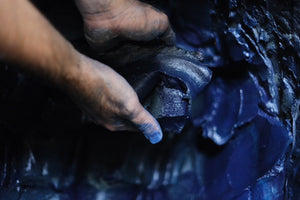
Manufacture of Precipitated indigo
The indigo production season runs from late April through the end of July each year. In Okinawa, harvesting and production take place during the rainy season, making this the busiest time of the year.


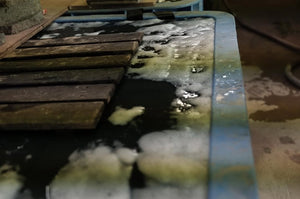
Water temperatures are lower than usual this year, and because fermentation is proceeding more slowly, it’s difficult to determine the right time to harvest the indigo leaves. Since this is something we can’t control artificially, it’s a battle against nature. We’ll keep a close eye on things with patience.
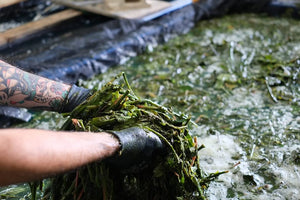
We determine the optimal time to remove the indigo leaves by observing how they dissolve and checking the color of the water. To extract as much pigment as possible, we repeatedly check the condition of the solution.


Once you have extracted enough pigment from the indigo leaves, remove the leaves and add shell lime dissolved in water to the liquid to raise the pH and create a highly alkaline environment. Stir the mixture for a while and introduce air. Stirring and introducing air causes the extracted pigment to combine with oxygen, gradually turning the liquid blue. As air is introduced, bubbles form, causing the mixture to become bubbly and foamy.
Completion of Precipitated Indigo
After undergoing various processes, the pigment blocks that produce RYUKYU BLUE—known as “Precipitated Indigo”—are finally complete.
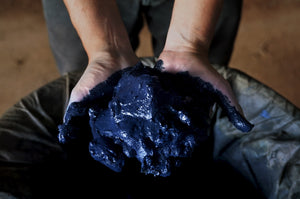
Regarding the Sale of Precipitated Indigo (Mud Indigo / Powder)
Precipitated Indigo (Mud Indigo) [100g]
Precipitated Indigo (Mud Indigo) [1kg]

Precipitated Indigo (Powder) [50g]
Precipitated Indigo (Powder) [500g]
How to Use Precipitated Indigo (Mud Indigo / Powder)
Since indigo is a concentrated form of pigment extracted from plants, it can be used as both a dye and a pigment.

- How to Use as a Dye -
When using indigo as a dye, a process known as “indigo preparation” is required. There are three main methods of indigo preparation: 1. Lye-fermentation method, 2. Glucose-fermentation method, and 3. chemical-fermentation method. Since proper management of the preparation process depends on the specific conditions of the environment, a basic understanding of indigo preparation is essential. Effective management of the indigo affects both the duration during which it can be used as a dye and the amount that can be dyed; therefore, proper management allows for dyeing larger quantities.
1. Lye-fermentation method
This technique involves using lye made from wood ash, along with rice bran, oyster shell ash, and sake, to create an environment where microorganisms that reduce indigo pigments can thrive, while carefully controlling the temperature and pH. The process takes about one to two weeks, depending on the specific conditions. This has been the primary method used in Japan.
2. Glucose-fermentation method
This technique involves dissolving indigo powder in water and using starch syrup or molasses along with awamori to reduce the indigo pigment while carefully controlling the temperature and pH, thereby preparing the pigment for dyeing. The process takes approximately one to two weeks, depending on the specific conditions under which the indigo preparation is carried out.
3. chemical-fermentation method
This method involves dissolving indigo in water and adjusting the pH using hydrosulfite and caustic soda to render the indigo pigment ready for dyeing. While it is possible to prepare the dye in about 30 minutes to an hour, extreme caution must be exercised when handling chemicals such as caustic soda, as they are highly toxic.
- How to Use as a Pigment -
Indigo powder can be dissolved in water and mixed into plaster or paint to be used as a pigment for fixing color to building materials or fabric. While it can also be used as a painting medium for brushwork, the required additives vary depending on the substrate material. Therefore, it is necessary to consider the intended use, the substrate material, and the environmental conditions of the application site when determining the application and finishing methods.
Contact Us
Whether you're new to indigo dyeing or an experienced dyer, please feel free to contact us with any questions about how to use this product.

